


The 2025 Integrated Report measures the value INWIT creates across the areas and communities where it operates. This series of stories turns those figures into real-life narratives, taking them back to the places where that value is generated.
Summer 2026 is already confirming itself as one of the hottest to date. Twelve months ago, July 2025 was recorded as the third-hottest month ever measured in Italy. Heatwaves are no longer the exception but the new reality in which the country’s infrastructure, including INWIT’s towers, is required to operate every day.
Every piece of infrastructure hosts electronic equipment that works without interruption, twenty-four hours a day, generating heat that is dissipated through air-conditioning systems designed to keep the equipment in optimal operating conditions.
When outside temperatures remain high for several consecutive days, however, even these systems come under pressure. Inside the shelters — the cabins housing network equipment — temperatures can exceed 40°C, putting the operation of radio base stations at risk.
During the May–July 2025 period—the most critical quarter from a climate perspective—INWIT recorded an increase in corrective maintenance interventions compared with the same period of the previous year: +5.93% for Priority 1 interventions, which involve the most strategic sites and require a response within six hours, and +4.05% for Priority 2 interventions, which require a response within ten hours.
The highest volumes were recorded in June, when nearly 1,500 Priority 1 and almost 3,000 Priority 2 interventions were successfully managed through dynamic resource planning, ensuring high standards of service continuity despite the increased operational pressure.
This trend is also confirmed by the 2026 data: the intensification of heatwaves is leading to an increase in maintenance activities, but the operating model is designed to absorb these peaks and ensure the resilience of the network.
2025 was not only a year of record temperatures; it was a test bed for the resilience of INWIT’s entire infrastructure network.
In March, a torrential rain hit Tuscany, causing power outages, flooding and difficulties in accessing sites. At the most critical moments, up to 13 sites were affected by the emergency at the same time. The technical teams stepped in with clean-up work, restoration of power supplies and securing of technological environments until the situation returned fully to normal.
Preventing failures before they happen
Maintenance of INWIT’s infrastructure is based on an integrated model whose operational core is the Maintenance Management System (SGM), the platform that plans, monitors and tracks all maintenance activities, from scheduled work to corrective and extraordinary interventions, through to the management of certifications and safety measures.
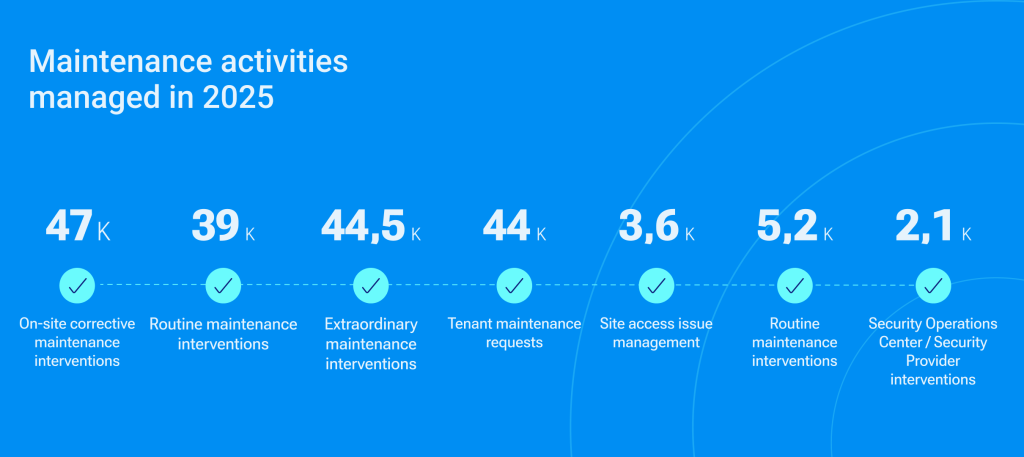
Every report is handled within 30 minutes and followed through to full resolution. In 2025 the system handled 47,000 corrective interventions, 39,000 routine maintenance operations and 44,500 extraordinary ones, in addition to more than 44,000 reports from the operators hosted on INWIT infrastructure. The result: average network availability of 99.93%, with restoration times of between 6 and 10 hours for the most critical infrastructure.
The next step is predictive maintenance, which, through the integrated use of sensors, telemetry systems, data analysis and artificial intelligence, makes it possible to pick up early signs of infrastructure deterioration, allowing action to be taken before an anomaly turns into a service disruption.
From predictive maintenance to the circular economy
Air-conditioning systems are a concrete example of this preventive approach.
Through continuous monitoring of performance, it is possible to identify when an air-conditioning unit is progressively losing efficiency and to replace it before it becomes unusable. This reduces sudden failures, urgent interventions and the risk of service interruptions.
The equipment that is removed is not simply replaced. Where possible, it is regenerated or sent for recovery processes at the Maddaloni logistics centre. In this way, smart maintenance not only helps to ensure service continuity, but also extends the life cycle of equipment and materials, reducing the consumption of new resources, in support of the principles of the circular economy.
When urgent action is required, local field teams distributed across the country come into play, supported by local warehouses that make it possible to reduce response times even in the hardest-to-reach areas.
The challenge of major events: continuity without interruption
Alongside emergencies linked to natural phenomena, in 2025 INWIT also dealt with other extraordinary events that called for an equally intense operational presence.
The funeral of Pope Francis, the conclave that led to the election of Leo XIV and the subsequent Jubilee of Young People drew hundreds of thousands of people to the capital, testing the ability of the infrastructure to sustain exceptional traffic peaks.
To ensure the full operation of the most heavily loaded infrastructure, including the DAS systems at Termini and Tiburtina stations, key hubs of city mobility, INWIT activated round-the-clock technical teams on site. The same operating model was applied at Tor Vergata during the Jubilee of Young People, which saw the participation of more than one million pilgrims.
Every emergency is different, but all of them have helped to enrich and strengthen INWIT’s store of experience, reinforcing the model with which the company monitors, manages and makes its network ever more resilient.
May 2026: INWIT inaugurates the INOC
This journey reached a major milestone in May 2026 with the inauguration of the INOC (INWIT Network Operations Center), INWIT’s proprietary hub for the monitoring and management of its entire technological infrastructure.
The INOC serves as the operational heart of INWIT’s national network. From here, a dedicated team monitors telecommunications towers, DAS systems, IoT sensors and gateways around the clock, managing alarms, work orders, faults and extraordinary events in real time to ensure the continuity and reliability of the network.
The facility combines standardised operating processes with advanced monitoring technologies, automation and Artificial Intelligence to detect anomalies early, optimise maintenance activities and support faster, more effective decision-making.
Looking ahead, the INOC is designed to further strengthen INWIT’s predictive maintenance capabilities. Planned developments include the integration of Civil Protection alerts and national extreme weather forecasting systems, enabling operational data from the network to be correlated with environmental information. This will allow preventive actions to be planned in the areas most exposed to climate-related risks, improving readiness before critical events occur.
This evolution reflects a broader vision of maintenance: one that moves from responding to issues to anticipating them. Because the resilience of connectivity depends not only on the quality of infrastructure, but also on the ability to foresee potential risks, prepare in advance and intervene at the right time.
This is the ambition of smart maintenance: bringing together people, technology and data to make one of the country’s critical infrastructures more resilient every day.